


What you can learn from your pet business market with Facebook's new page insights
 Last week Facebook announced new page insights for Facebook page managers. And this week it's being rolled out.
While the previous FB page insights was fairly helpful in getting to know your audience, the new insights are much more in depth and helpful. Let's take a look at what you can learn about your pet business market through your Facebook page insights:
Overview Tab
When you click on the 'Check out the new Page insights' button on your admin panel, the first page you see is the overview page. The overview page shows you a snapshot of Page Likes, Post Reach, Engagement and recent post data for the past seven days. You have the ability to click on each section to dig a little deeper into your data and change time frames.
Page Tab
Page Likes:
The Page Likes insight page outlines information about those who have liked your page, defaulting to approximately 30 days of data, with a handy slide that allows you to increase the time frame. Scrolling down you can see a breakdown of those likes including if they were through organic traffic or paid traffic, as well as unlikes. Scrolling a bit more you can see how consumers/individuals found you to like your page, whether it be from ads/sponsored stories, on your page directly, through page suggestions from others, or via mobile devices.
Post Reach:
While on the Page Likes tab you can click the next tab to see Post Reach which will show you how many people saw your posts and check virality; likes, comments and shares of posts overall; how many have unliked or hid your page because of a post, and the number of people who saw any activity from your page including posts, posts by other people, page like ads, mentions, and checkins.
Page Visits:
On this tab within the Page Tab section of FB insights you can see how many times various tabs or the timeline of your page was viewed, the number of actions individuals took that involved your page, and the external referrers to your FB page.
Post Tab:
All Posts:
The post tab contains some very valuable information at a glance about what individuals like about your page and your individual posts including what posts are more popular in reach and engagement as compared with other posts on your page.
When your Fans are Online:
This tab is key to helping you understand when your page likers are online by showing the average number of people who saw any posts on Facebook in an hour. All my pet business related FB pages have a peak online time of 9 PM ET.
Best Post Types:
This tab showcases which type of posts are more popular than others including video, links, and photos by showing clicks, likes and comments. Additionally, you can click on each individual post and see more insights related to that specific post.

People Tab:
Your Fans:
The Your Fans Tab showcases demographics of your FB audience and compares the people who like your Page with everyone on Facebook to understand what makes your audience unique. The overall demographics of several of my, and my clients, pages range from 80-90% women, with the primary age range between 24-60 years of age; whereas FB primary audience is between the ages of 25-35. Scrolling down you can also see the primary countries and cities of your audience.

People Reach:
This tab can help you better understand if you are reaching your main target audience by showcasing the people you are reaching on FB, as well as help you understand if you are reaching additional and secondary target audiences for your pet business. For example: in testing a variety of promotions we've been seeking to reach a younger audience on several of my FB pages. This data has allowed me to better understand if these promotions have been successful or need to be adjusted.
People Engaged:
This tab showcases much of what is indicated in people reach, however it takes it a step further to showcase engagement data, in addition to reach data.
What does all this tell you about your pet business consumer and how you can best market to your current and prospective customer audience?
From this data you can tell what type of individuals are interested in what you have to offer and more, including:
- Gender of your audience
- Target age range
- What devices are most popular with your audience
- Which FB promotions, ads or sponsored stories are more popular than others
- How individuals are finding your FB page
- When your likers are online
- What types of posts are more interesting to your audience than others
- Locations of FB audience you are targeting
- Targeting specific gender and age ranges
- Targeting advertisements on specific preferred devices of your audiences
- How your audience prefers to be communicated with
- If your ads and sponsored stories are working for your benefit and how you may be able to improve them
- Understand when to post during peak times of the day when your audience is most online on Facebook
- Gain knowledge of what types of content your audience prefers
- Help you understand if you are reaching your target audience, as well as expanding your reach to up and coming younger audiences that will become increasingly important in your future marketing efforts
As you can see the Facebook new Page Insights can really help you in marketing your pet business. Dive in and get educated!
US Bureau of Labor Statistics releases 'Spending on Pets' report.
 Just last week the US Bureau of Labor Statistics released their ''Spending on pets: “Tails” from the Consumer Expenditure Survey," which outlines a wide variety of information relating to pets and pet ownership.
Prepared by Steve Henderson, a supervisory economist in the Office of Prices and Living Conditions, US Bureau of Labor Statistics, the information includes statistics gathered by the U.S. Bureau of Labor Statistics (BLS), Census Bureau, Consumer Expenditure (CE) Diary, the U.S. Department of Labor and interview surveys from 2007-2011.
Interesting key facts contained within the report include:
- Nearly three-quarters of U.S. households own pets totaling 218 million pets in the United States (not including pet fish).
- Americans spent nearly $61.4 billion in total on their pets in 2011, spending an average of just over $500 annually on pets per household.
- Even in lieu of the recession, pet loving families spent consistently on pets from 2007 through 2011, with the share of pet spending staying fairly constant within a range of .9 to 1.1 percent of total household spending.
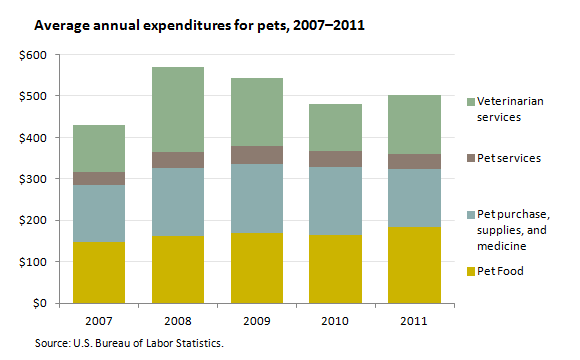
- Pet food was the largest expenditure, rising to an average of $183 in 2011.
- Married couples without children living at home spent the most on their pets in 2011, spending $698 on average, followed by a close second by married couples with children over 18.
- The report also noted: 'married couples with children spent the least on pets when their oldest child was under 6; this expenditure rose by more than $100 if the oldest child was between the ages of 6 and 17, and increased another $100 when the oldest child at home was over age 18.'
- Single-parent households with at least one child under age 18 spent the least on pets, with an average of $267.
- Predictably, the amount households spent on pets rose with income. The middle income families ($35,600 to $58,200) spent $485 on pets annually, more than double the $216 spent annually by the lowest segment (income less than $18,558). The highest pet loving income segment (from $93,800 and up) spent $870 on pets in 2011, more than four times as much as the lowest segment. However, the relative share of spending on pets to total household expenditures stayed near the 1 percent mark for each income segment.
- Not surprisingly, homeowners spent nearly three times as much on pets as renters in 2011, however, surprisingly households in rural areas spent ($716) considerably more than those in central city areas ($393).
- Households with a reference person under 25 had the lowest expenditures per year, with an average of $279 in 2011. This amount steadily increased as the age of the reference person increased, peaking at $636 for ages 55 to 64. It dropped to $547 for reference persons ages 65 to 74 and then to $286 for those 75 and older.
The Editors Desk: Household spending on pets
Beyond the Numbers: Spending on pets: “Tails” from the Consumer Expenditure Survey
Leslie May, founder of PM, featured in article in Newsweek/The Daily Beast.
 Leslie May, founder of Pawsible Marketing, was featured in the May 29, 2013 issue of Newsweek and The Daily Beast, in an article entitled, 'Enterpreneurs Create Apps and Web-Based Businesses to Appeal to Dog Owners.'
"Although there is currently money
to be found in investing in a pet
lover’s playground, May warns that
the tides may be changing. “Baby
boomers are getting older, which means
that they may not have a pet because
of life-expectancy issues,” she says.
“We are going to see a shift in who
purchases these pet products from the
baby boomers to the Generation X’s to
the millennials."
Read the full article on The Daily Beast.

Content marketing can be a powerful tool for your pet business.

What is content marketing?
"Content marketing is a marketing activity revolving around the creation and distribution of relevant and valuable content and information to engage, attract, and acquire a clearly defined and understood target audience with the objective of increased sales."For pet businesses, with millions of pet owners, content marketing can be very powerful as this audience is always on the hunt for information to help their pets with health and wellness issues, new and innovative products, activities and fun things to do, the latest news and information, and more.
By providing rich, original content to your target market and audience, you have the ability to attract and draw this prospective audience right to you virtual or physical doorstep, if you do it right.
Here are a few key thoughts that I've found to make a content marketing program for pet businesses the most successful:
- Content marketing is not an 'island.' By integrating your content marketing into your marketing mix and utilizing all your marketing resources together and effectively can greatly increase your marketing efforts and stretch your marketing dollar.
- The content you provide needs to be original, geared and targeted to your specific audience, whether it be national or local in scope, and designed to engage and attract.
- There are various ways to provide content marketing including via a blog, YouTube, Google+, Facebook, Twitter, Pinterest, Tumblr, email newsletters or via your website, all designed around your brand and your expertise.
- Experimenting with your content, and consequently gauging acceptance and response from your target audience can provide valuable insight into what your customers and prospective customers want and need from your pet business.
- Your content needs to be the best in your pet business niche to stand out from the crowd, and as a result can effectively build your brand and increase sales.
- The planning of your annual content marketing is imperative, and delivering on that plan is very important to providing a reliable and consistent program that your pet business audience can rely on and trust, and come back for more, often.
- To outsource or not to outsource? That's a big question. You may be able to outsource your content marketing program, but if you do make certain that your provider is creating original content (not content copied from other sources) and be sure that the content your outsourcer provides is powerful, extremely relevant to your audience and provides a consistent voice for your brand. Outsourcer must be experienced, and fully understand and have the ability to speak to your audience.
- Content marketing can be time sensitive. Pet parent issues often are seasonal in nature, revolve around holidays, and can be reactive to national and local news related issues. Be prepared to move quickly with your content when the need arises.

For more information about how to add content marketing efficiently and effectively to your marketing mix, feel free to contact Pawsible Marketing for assistance in building your program for the highest level of effectiveness for your pet business.
Photo credits: DougWoods and Angela N.
Leslie May, founder of PM, featured in Progressive Grocer Magazine.

"Big-box stores and supermarkets already
committed
to the pet-loving market will
continue to grab market share and
expand shelf space, concentrating on
consumer demands of healthier
products for their pets."
- Leslie May, Pawsible Marketing
Read the full article here on Progressive Grocer's website.
Subscribe to:
Posts (Atom)
LinkWithin
